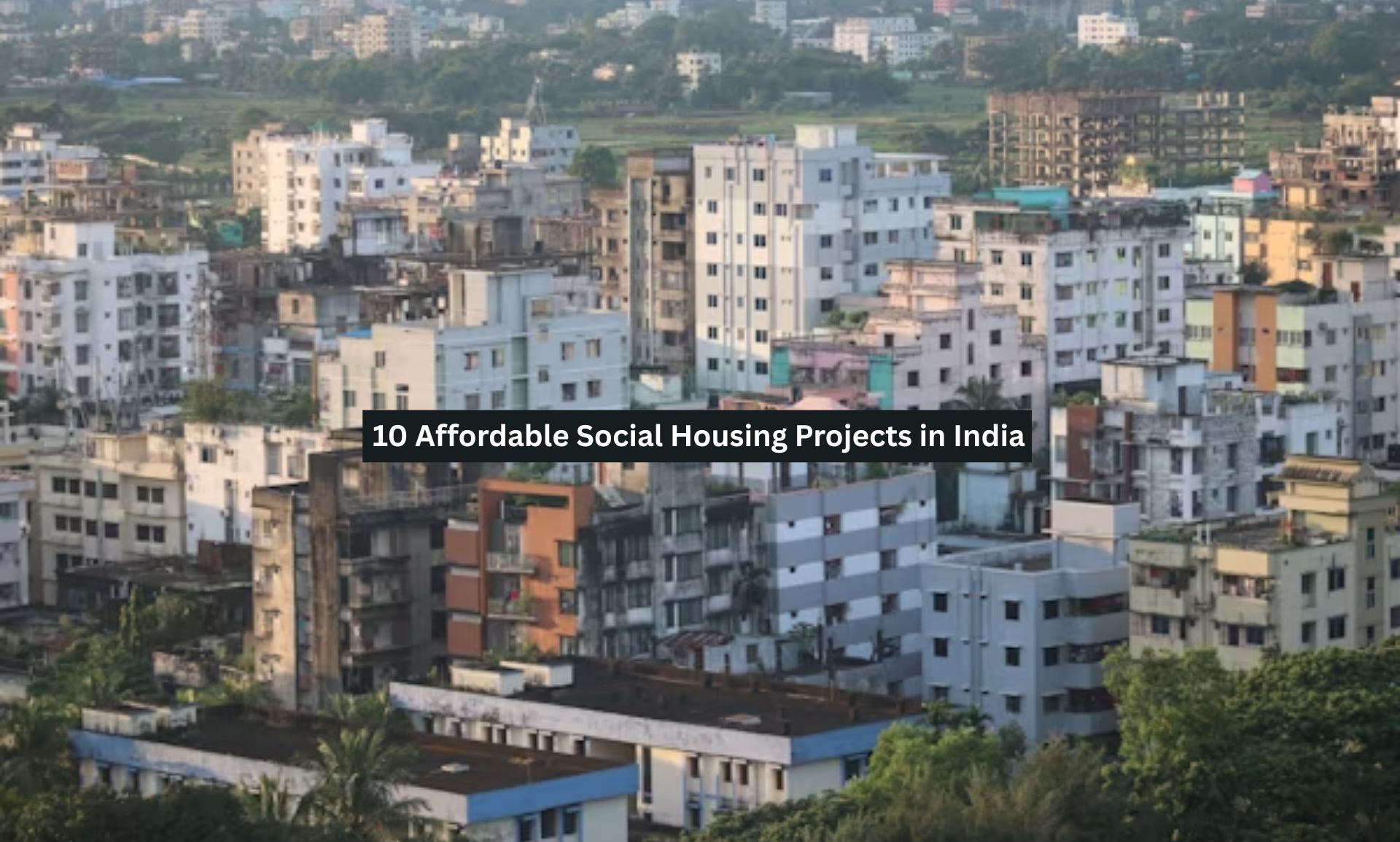
Indian architecture has usually valued cultural variety and network, that’s meditated in its social housing schemes. As urbanization and international innovation have changed housing developments, Indian designers are specializing in low-value and sustainable social housing programs to fulfill the call for.
However how can we create those holistic yet social community settings? Social housing ought to hire sustainable building methods and substances to acquire the goal of inexpensive housing. India is one country that boasts some of the maximum successful social housing initiatives. Right here, in this text, we’ve got compiled a listing of 10 less expensive housing initiatives in India that are altering the method we consider large-scale social housing applications.
10 Innovative Low-Cost Housing in India
01. Aranya Network Housing
Location: Indore, Madhya Pradesh
Grasp architect BV Doshi used to be absolutely privy to the ever-extending family dynamics of Indian families and proposed a low-upward thrust, excessive-density grasp sketch for the assignment. The 85 hectares’ moderate slope decided the route of infrastructure serving the 6,500 plots. Niches and quiet corners maintain intimacy, but courtyards and extensive terraces permit life’s richness to overflow into those efficiently designed hierarchical social spaces.
The overall design was centered on instilling a experience of belonging, encouraging population’ participation, and allowing human beings to expose their ambitions, connections, and social dynamics.
Trivia: Aranya Low-fee housing is one of the first projects to integrate the thought of fee-powerful making plans with humane layout concepts.
02. The Stanwood Residency
Location: Halol, Gujarat
The Stanwood house is a area architectural mission with stilt residences and 2-bed room houses that are distinguished through vivid colorings and cutting-edge fashion. The row houses have sloping roof terraces, even as the condo block prioritises ventilation and herbal mild. It is the aim of the initiative to offer each person with access to tremendous homes.
In this row residence design, roof terraces with sloping walls that seem to have been scooped out of the façade provide striking visuals. In assessment to the herbal panorama, straight lines and angles dictate the spatial layout. With modest balconies and considerable openings, the rental constructing ensures unrestricted ventilation and herbal light.
03. Tara Housing
Location: Delhi, India
Master Architect Charles Correa firmly believed that high-upward jostle buildings disconnected their population from society. This precept led him to layout the Tara cooperative, which has a hundred and sixty units in 4-storeyed modules peppered with thrilling open spaces. All gadgets have views of the centre courtyard, that is extra of a network area. Open stairs connect the centre Courtyard to each residential unit.
Strategic planning based on climatic factors makes this housing least expensive as well as a social initiative. As an example, the space among the dwellings generated reciprocal colour whilst additionally lowering the tension of the lengthy constructing facade, making the construction greater human-scale.
04. Housing for Mahouts and Their Elephants
Location: Jaipur, Rajasthan
This social housing catered to a selected community, i.e the Mahouts and their elephants. Rajasthan’s Public Works branch commissioned RMA Architects to create this less costly network housing.
The site graph used a clustering method to create shared not unusual spaces at diverse hierarchies for you to foster a sense of network a few of the citizens. Courtyards and terraces beautify the otherwise minimum budgeted space of 40 square for this ordinarily low priced housing complicated.
Trivia: The diagram strategy entailed rebuilding the topography, which used to be degraded with the aid of sand quarrying. This also covered building water bodies for rainfall collecting and farm animals preservation in Rajasthan’s wasteland surroundings.
05. CIDCO Housing in Navi Mumbai
Location: Navi Mumbai, Maharashtra
Raj Rewal’s association was once hired to build 1,000 social housing devices for low-earnings groups as an test in city making plans and architecture in New Mumbai. The 1,048 apartments required underneath the scheme had been a mixture of smaller one-to-2-room gadgets and bigger two-bed room devices that were to be bought one by one.
Primarily based on pedestrian language, the graph constructed a dwelling ensemble of diverse clusters and restrained regions that emerged from and melded into the panorama. Intimate courtyards and shaded pedestrian paths play a full-size social function in the low-upward jostle, high-density chains created with the aid of becoming a member of the blocks.
06. Elegant Ordinaries Housing Challenge
Location: Vasind, Maharashtra
The Mumbai Chawls’ single-loaded corridor style acts as a catalyst for growing a sense of network in this social housing challenge. Chic Ordinaries, designed through DCOOP Architects, is positioned northeast of Mumbai, housing fifty four households of personnel running in an industrial facility. The four flats on each floor are connected with the aid of a shared hallway, which incorporates a staircase at one stop. Those functions were given a tinge of modern aesthetics, making them more thrilling and harmonious.
Trivia: The architects included conventional elements to sculpt the social spaces of the venture. Flats on the lowest stage are accessed one by one by way of their modest semi-non-public location or Otla.
07. Sheikh Sarai Housing Complex
Location: South Delhi
Sheikh Sarai Housing complicated in South Delhi, designed through architect Raj Rewal for low-upward thrust, high-density residing, integrates unit diagram with pedestrian networks and community areas stimulated with the aid of Haveli, with clean barriers between automotive and pedestrian streets to promote pedestrian traffic.
A transition from private areas to public squares of numerous sizes with shaded routes strolling thru them served as the basis for the relationship between the man or woman and the network.
Trivia: Primarily based at the Haveli typology, Sheikh Sarai’s plan creates most desirable assemblages of network dwellings by means of enhancing, refining, and perfecting traditional urban spatial layouts.
08. Chengalchoola Housing
Location: Trivandrum, Kerala
Chengalchoola Housing’s sketch deviates from the place’s typical repetition-primarily based massing of social housing schemes. This housing used to be a slum redevelopment undertaking undertaken by Laurie Baker. This undertaking was supposed to be a bridge among cheap high-rises and relatively pricey higher-density low-rises.
Baker blanketed enough open areas, hence developing a sense of network within the clusters.
Trivia: Baker breaks away from regular slum rehabilitation tasks by using the use of a thoughtful palette of locally sourced labour and uncooked substances.